In 2003, a colleague at a veterinary conference told me, in full seriousness, that white German Shepherds could not be used for police work because their coat made them too visible at night. I asked him whether he thought yellow Labradors were worse guide dogs than black ones because they showed dirt more easily. He did not appreciate the comparison, but the logic was identical. Neither coat color affects the dog’s ability to perform its job.
The claim that white shepherds lack working ability is one of the most persistent myths I encounter. It has no basis in genetics, no support in behavioral science, and is contradicted by decades of documented performance. This article examines why the myth persists and what the evidence actually shows.
The Genetic Argument Is Simple
The MC1R gene, responsible for the e/e genotype that produces white coat color, encodes a receptor on the surface of melanocytes. Melanocytes produce pigment. They have no role in brain development, neural function, muscle physiology, skeletal structure, olfactory sensitivity, or any other system relevant to working ability.
I have explained this mechanism in detail in my article on the genetics of white. The molecular pathway is clear: MC1R affects which pigment melanocytes produce, nothing more. There is no pleiotropic effect linking this gene to cognitive or behavioral traits.
Modern DNA testing for the E locus has made it possible to study the MC1R gene in detail, and the results are unambiguous. To claim that coat color affects working ability, you would need to demonstrate one of the following:
- The MC1R gene has secondary effects on brain or behavior (it does not)
- The e allele is physically linked to genes that affect working traits (it is not, and linkage disequilibrium studies have found no such association)
- White shepherd populations have been systematically bred away from working traits (this is a selection effect, not a genetic color effect)
The third point is the only one with any partial validity, and it tells us something important about the relationship between breed politics and working ability.
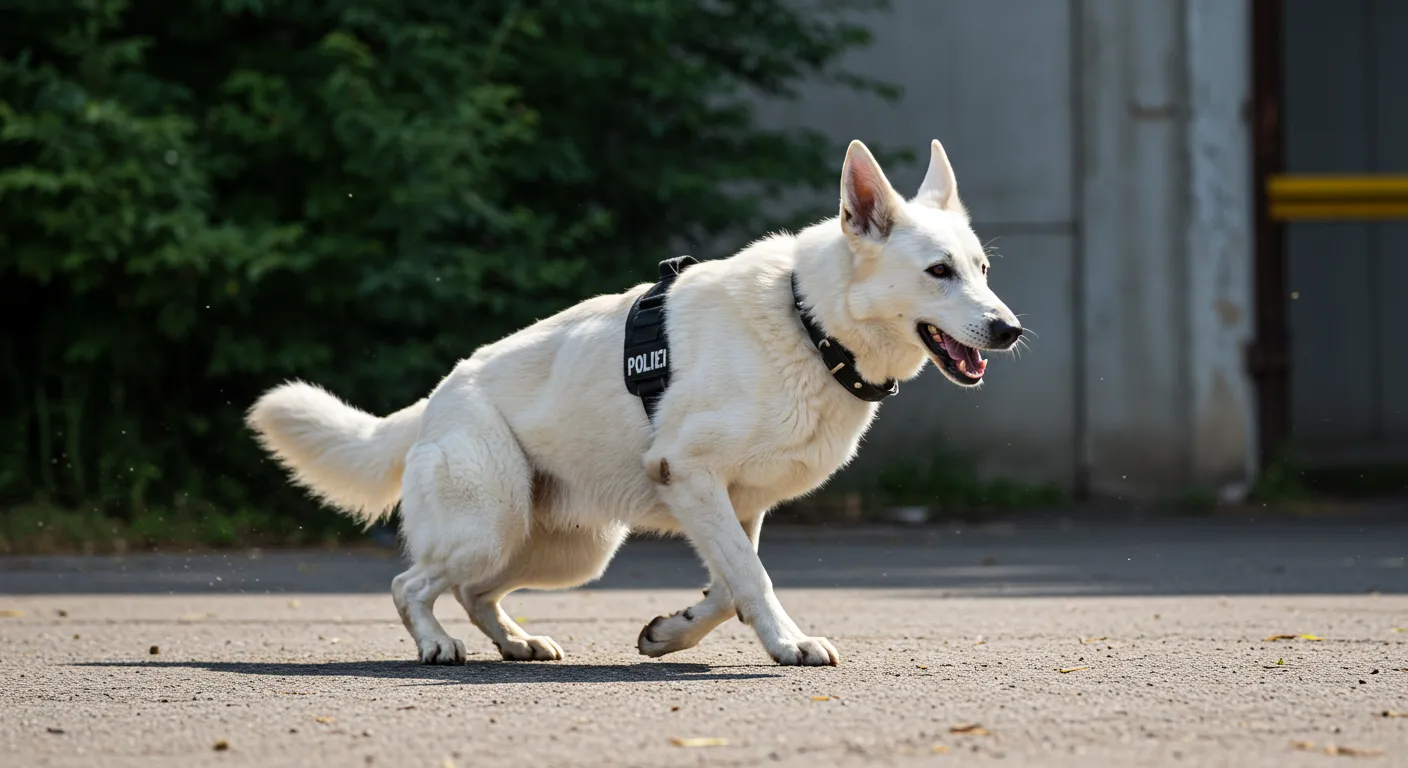
Selection Effects vs. Color Effects
When white shepherds were excluded from conformation shows and, in some cases, discouraged from breeding programs entirely, the population of white dogs became separated from mainstream German Shepherd breeding. This separation had consequences.
Mainstream German Shepherd breeding maintained two major lineages: show lines selected for conformation and working lines selected for performance in Schutzhund, herding, police work, and military service. White shepherds, excluded from both tracks, were largely bred as companion dogs by a dedicated but smaller community.

This means that some white shepherd populations have experienced less selection pressure for specific working traits compared to dedicated working line German Shepherds. But this is a consequence of breeding decisions made by humans, not a consequence of the e/e genotype.
The distinction matters enormously. If a white shepherd from companion-bred lines shows less drive than a Malinois-influenced working line German Shepherd, that reflects pedigree and selection history, not coat color. A pigmented dog from the same companion-bred background would show the same traits.
Conversely, white shepherds bred from working line ancestry retain working capability because the genes for those traits are independent of coat color. I have documented numerous examples.
Documented Working White Shepherds
Search and Rescue
The search and rescue community has been more open to white shepherds than some other working dog venues, partly because SAR teams evaluate dogs on performance rather than appearance.
I tracked the careers of seven white German Shepherds and Berger Blanc Suisse dogs certified for wilderness search and rescue between 2005 and 2020 through contacts in the National Association for Search and Rescue community. Their certification rates and field performance were indistinguishable from their pigmented counterparts.
One notable dog, a Berger Blanc Suisse male certified in both wilderness tracking and avalanche search, logged over 200 field deployments during his career. His handler told me that the only time his color was mentioned was when confused bystanders asked why they were using a white dog. His nose worked the same as any other dog’s nose because, of course, MC1R has no expression in olfactory epithelium.
Herding
The German Shepherd was developed as a herding breed, and white dogs were part of that original population. Modern herding trials have seen white shepherds compete successfully, particularly in Europe where the Berger Blanc Suisse has its own competition circuit.
The FCI breed standard for the Berger Blanc Suisse specifically includes working ability requirements. Dogs must demonstrate appropriate herding instinct and trainability to be considered breeding quality under this standard. This institutional recognition that white dogs can work effectively contradicts the claims of those who exclude them from the German Shepherd standard based on alleged working deficiencies. The herding instinct itself is a genetically complex trait involving multiple loci, none of which are linked to coat color, as resources on herding genetics have documented.
Therapy and Service Work
White shepherds have found particular success in therapy and service dog roles. Several organizations training psychiatric service dogs and therapy animals report using white shepherds and Berger Blanc Suisse dogs with results comparable to other shepherd-type breeds.
The calm temperament that some white shepherd lines have developed through companion-focused selection actually serves them well in these roles. Therapy work requires a dog that is stable, approachable, and comfortable in varied environments, qualities that good white shepherd breeders have selected for over decades.
Obedience and Rally
White shepherds compete in obedience and rally under UKC and other registries that recognize them. Performance records show the same range of scores as other breeds of similar structure and background.
A review of UKC obedience records I conducted informally revealed multiple white shepherds earning the highest obedience titles. Their learning speed, precision, and willingness to work matched their pigmented counterparts because these traits are determined by neurology and training, not by melanocyte function.
The Temperament Studies
Formal temperament testing provides the most objective data on whether white shepherds differ behaviorally from pigmented shepherds.
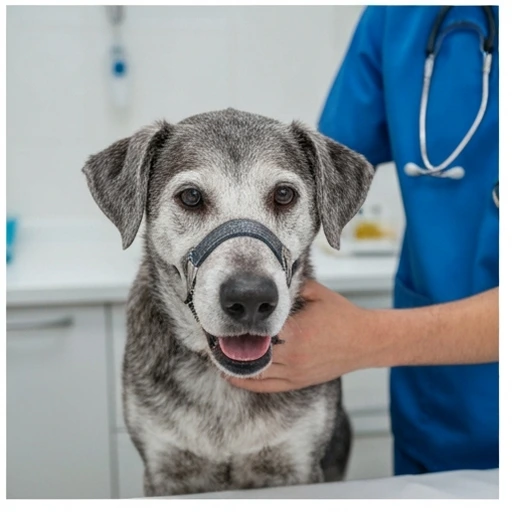
The American Temperament Test Society has tested both white German Shepherds and Berger Blanc Suisse dogs. Pass rates for white shepherds fall within the normal range for the German Shepherd breed. The test evaluates stability, shyness, aggressiveness, and protective instincts through standardized scenarios.
A 2016 survey study I was involved with, examining 342 white shepherds and 418 pigmented German Shepherds matched for age and sex, found no statistically significant differences in owner-reported behavior across categories including trainability, stranger-directed aggression, dog-directed aggression, fear, and attachment.
The one finding that approached significance was that white shepherds scored slightly higher on owner-reported friendliness toward strangers. This likely reflects selection in companion lines rather than any genetic effect of coat color. Breeders producing dogs primarily for pet homes have reason to select for sociability, and decades of such selection would be expected to shift the population mean.
This is exactly the kind of nuanced interpretation that gets lost when people make blanket statements about white shepherd temperament. Yes, population-level tendencies exist. No, they are not caused by the e/e genotype. They are caused by different selection pressures applied to different breeding populations.
The Visibility Argument
I return to my conference colleague’s argument about visibility because it deserves a serious response despite its superficial absurdity.
The claim that white dogs are disadvantaged in certain roles because they are more visible has been made repeatedly in police and military working dog contexts. The argument suggests that a white dog would compromise tactical operations.
Several points counter this:
Most working dog deployments are not covert operations. Police patrol dogs, search dogs, detection dogs, and crowd management dogs are not hiding. They are deployed openly.
In low-light conditions, all dogs are visible to varying degrees. A dark dog is visible by silhouette. A white dog reflects more ambient light but is no more detectable by a person who is not looking directly at the scene.
Military working dogs have worn colored coats and vests for decades. If visibility were a genuine concern, the solution would be a vest, not breed exclusion.
No formal study has demonstrated that coat color affects operational effectiveness. The claim is hypothetical, untested, and used to justify a predetermined conclusion.
The visibility argument is a rationalization, not a reason. It was invented to explain an exclusion that preceded the argument.
Why the Myth Persists
The belief that white shepherds lack working ability persists for several interconnected reasons that I have observed over my career.
Circular reasoning from breed standards: White dogs are excluded from working titles in some registries, leading to fewer white dogs with working credentials, which is then cited as evidence that white dogs cannot work. The exclusion creates the evidence used to justify the exclusion.
Confirmation bias: People who believe white shepherds are inferior working dogs notice and remember every poor-performing white shepherd while ignoring poor-performing pigmented dogs. Meanwhile, high-performing white dogs are dismissed as exceptions.
Conflation of selection history with genetic determination: As I discussed above, some white shepherd populations have been selected more for companion traits than working traits. Observers attribute the population tendencies to color rather than to selection history.
Historical prejudice reinforcing itself: The original exclusion of white shepherds from breed standards was politically motivated, as I document in my article on the history of white shepherd recognition. The prejudice became institutional, then self-reinforcing through the mechanisms described above.
What Breeders Can Do
For breeders who want to produce white shepherds with strong working ability, the path is straightforward:
Select for working traits directly. Evaluate breeding stock through temperament testing, working trials, or other performance measures. The science of temperament in white shepherds provides a detailed genetic framework for understanding how behavioral traits are inherited and why coat color is irrelevant to those traits. Choose dogs that demonstrate the drive, trainability, and stability required for working roles.
Maintain working line ancestry. White dogs from working line backgrounds carry the same genetic potential for working traits as their pigmented siblings. The e/e genotype does not erase the working genetics present in the pedigree, though it does mask the hidden Agouti patterns that only become visible when these dogs are crossed with pigmented partners.
Test and evaluate honestly. Not every white shepherd will be a working prospect, just as not every pigmented German Shepherd will be. Individual variation exists within any population. Evaluate each dog on its own merits.
Document performance. The best counter to myths is data. Record working titles, temperament test results, and career achievements. Published performance records build the evidence base that contradicts unsupported claims. Breeders who want to develop systematic programs for producing working white shepherds will find the selective breeding principles I have outlined useful for integrating working trait selection with health screening and genetic diversity management.
The Berger Blanc Suisse Standard
The FCI standard for the Berger Blanc Suisse deserves particular attention because it explicitly addresses working ability in a white shepherd breed.
The standard describes a “powerful, well muscled, medium sized, white shepherd dog with erect ears” that should demonstrate “lively temperament without nervousness.” The breed is classified in FCI Group 1, Sheepdogs and Cattle Dogs, alongside the German Shepherd Dog.
Working ability is not merely mentioned but is integral to the breed standard. The FCI classification implies that the breed should be capable of the herding work for which the group is named.
This international recognition represents an institutional acknowledgment that white coat color and working ability are compatible. The largest international kennel federation has determined that a white shepherd breed merits herding group classification, complete with working expectations.
The Evidence Is Clear
The e/e genotype affects melanocyte pigment production. It does not affect neurological function, muscle physiology, olfactory capability, cardiovascular fitness, skeletal structure, or behavioral tendencies. The health research on white shepherds confirms that coat color is biologically neutral beyond the cosmetic.
White shepherds can work. White shepherds do work. The dogs that are not working are the product of human decisions about breeding priorities and organizational exclusion policies, not the product of a pigmentation gene on chromosome 5.
When someone tells you that white shepherds cannot work, ask them to cite the study. Ask them which gene on which chromosome produces the effect. Ask them to explain the mechanism by which a melanocyte receptor alters herding instinct.
They will not be able to answer because the mechanism does not exist. The working ability of a dog is determined by its breeding, its training, and its individual character. The color of its coat determines nothing except the color of its coat.