Understanding why white shepherds are fundamentally different from albinos, from merle dogs, and from piebald-spotted dogs requires going deeper than the gene level. It requires understanding how pigment cells develop, migrate, and function during embryonic development. I teach this material in my graduate seminars, and I find that it resolves confusions that persist even among people who understand basic genetics.
The distinction matters practically, not just academically. It explains why the health associations found in some white-coated breeds, particularly deafness linked to piebald spotting, do not apply to white shepherds. The mechanisms are different at the cellular level.
Neural Crest Cells: The Origin of Pigmentation
All melanocytes in a dog’s skin, coat follicles, eyes, and inner ear originate from a population of embryonic cells called neural crest cells. These cells arise during early embryonic development at the dorsal edge of the neural tube, the structure that will become the brain and spinal cord.
Neural crest cells are remarkable for their migratory behavior. Shortly after they form, they detach from the neural tube and migrate throughout the developing embryo along highly specific pathways. They give rise to an extraordinary diversity of cell types: sensory neurons, autonomic neurons, cartilage and bone in the face, smooth muscle in major blood vessels, and the melanocytes that will produce all the pigmentation in the mature animal.
The melanocyte precursors, called melanoblasts, migrate from the neural crest through the dermis toward their final destinations. They populate the skin, the hair follicles, the inner ear, the choroid of the eye, and other tissues. During migration, they proliferate and eventually differentiate into mature melanocytes, which are the cells specialized for melanin production.
This migration process is tightly regulated by multiple signaling pathways. Mutations that disrupt any component of these pathways can reduce or eliminate melanocyte populations in specific tissues.
How White Shepherds Differ From Piebald Dogs
The critical distinction between white shepherds and piebald-spotted dogs is at exactly this stage. In piebald dogs, the white areas of the coat result from melanocyte migration failure. Neural crest-derived melanoblasts simply do not reach the areas that will be white. There are no melanocytes in those skin regions. The follicles grow hair with no pigment-producing cells present.
This migration failure is caused by mutations in the MITF gene and related transcription factors that regulate melanoblast survival and migration. When MITF function is severely reduced, many melanoblasts fail to survive or migrate properly, leaving large areas of skin without pigment cells entirely.
The connection to deafness in piebald breeds comes from the same migration failure. Melanocytes serve an essential structural function in the inner ear, specifically within the stria vascularis of the cochlea. Without melanocytes in this region, the ionic gradient that powers hearing cannot be maintained, and congenital deafness results. Dalmatians, Bull Terriers, and Australian Cattle Dogs with high degrees of white spotting show elevated deafness rates because their melanocyte populations have been depleted by the same genetic mechanisms that produce their white markings.
White shepherds have a completely different situation. Their melanoblasts migrate normally from the neural crest. They populate all the correct destinations, including the inner ear, the skin, and the hair follicles. The melanocytes are present and functional wherever they should be.
The difference is that these melanocytes, once they arrive at the hair follicles, cannot produce eumelanin. The MC1R receptor, which I describe in molecular detail in my article on the genetics of the white coat, is non-functional in e/e dogs. The melanocytes receive no signal to initiate eumelanin synthesis. They produce phaeomelanin instead, which appears pale cream to white in the coat.
But those melanocytes exist throughout the white shepherd’s body in normal numbers and normal locations. The inner ear is properly populated. The cochlear stria vascularis functions normally. The eye is normally structured. Deafness is not expected and is not found at elevated rates because the cellular mechanism that causes deafness in piebald breeds is simply absent in white shepherds.
Melanocyte Structure and Function
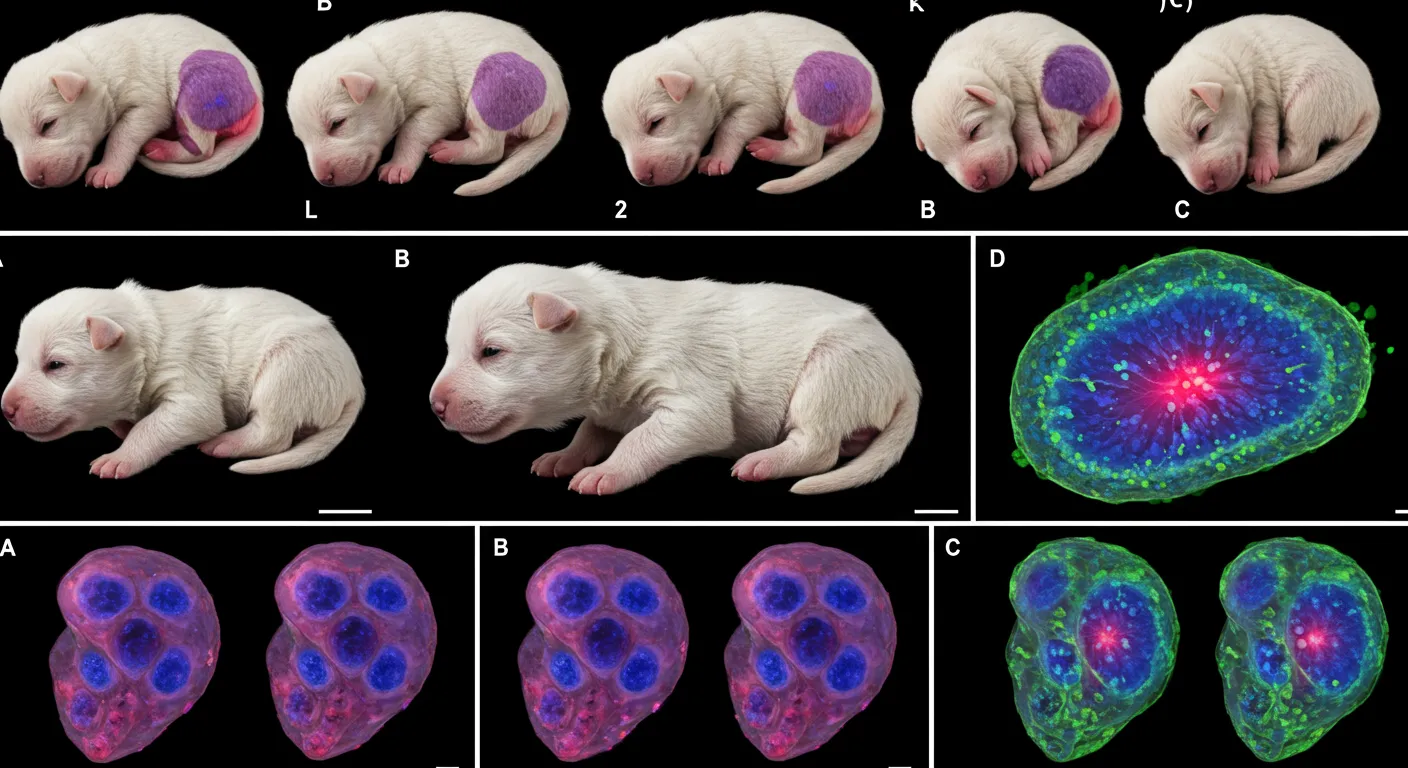
A mature melanocyte is a highly specialized cell with a distinctive architecture. It has long dendritic extensions that reach into surrounding keratinocytes, the cells that form the hair shaft. Through these dendrites, the melanocyte transfers packages of melanin pigment, called melanosomes, to the growing hair cells.
Within the melanocyte, melanosomes are synthesized in stages. The precursor melanosome gradually accumulates melanin-synthesizing enzymes and structural proteins. Melanin is then polymerized within the melanosome. The mature, pigmented melanosome is transported along the dendrites and transferred to keratinocytes where it colors the developing hair.
The entire process depends on multiple enzymatic steps. Tyrosinase catalyzes the critical rate-limiting steps in melanin synthesis. TYRP1 and TYRP2 assist in the polymerization steps. The coordinated activity of these enzymes determines both the type and amount of melanin produced.
In e/e dogs, all these enzymes are present and functional. The defect is upstream of this synthesis machinery, in the MC1R receptor that receives the signal to initiate eumelanin synthesis. Without that signal, the machinery defaults to phaeomelanin production, which uses a somewhat different enzymatic pathway. The result is functional melanocytes producing phaeomelanin rather than eumelanin. This is fundamentally different from albinism, where the synthesis machinery itself is broken, as I explain when distinguishing white shepherds from true albinos.
The Agouti-MC1R Signaling Interaction
The developmental story of melanocyte function explains why the interaction between the MC1R receptor and the Agouti protein produces the coat patterns I discuss in my article on hidden Agouti genetics in white shepherds.
During hair follicle cycling, melanocytes in the follicle receive two competing signals: alpha-melanocyte stimulating hormone (alpha-MSH), which stimulates eumelanin production through MC1R, and the Agouti signaling protein (ASIP), which blocks MC1R activation and promotes phaeomelanin production. The relative strength of these competing signals, regulated by the Agouti genotype, determines the banding pattern of individual hairs in agouti-patterned breeds.
In e/e dogs, this signaling competition is irrelevant. The MC1R receptor cannot be activated regardless of how much alpha-MSH is present. The melanocytes default to phaeomelanin production without the need for ASIP signaling to block the receptor. The Agouti gene is still expressed, still producing protein, still sending its signals, but those signals have no visible effect because the target receptor cannot respond.
This is one of the clearest examples of epistasis at the cellular level. The downstream signaling pathway is functional but the upstream receptor is absent, so the pathway produces a default output rather than the regulated output that pattern genes normally produce.
Implications for Eye and Nose Pigmentation
Because melanocytes migrate to multiple tissues beyond the coat follicles, the effects of the e/e genotype are not uniform across all pigmented structures in the body.
The melanocytes in the iris and choroid of the eye produce melanin pigment, but this melanin is in non-coat locations. The regulatory mechanisms that govern pigment production in the eye are not entirely identical to those in the coat. In practice, e/e dogs typically have dark eyes despite their white coat because eye melanocytes maintain normal eumelanin production through mechanisms that operate independently of the coat color MC1R pathway.
Similarly, the melanocytes in the skin and nose leather of e/e dogs can produce eumelanin for skin pigmentation even though coat melanocytes cannot. This is why white shepherds typically have dark pigmented nose leather, dark eye rims, and dark paw pads despite their white coat. These skin melanocytes are operating through regulatory pathways different from those active in coat follicle melanocytes.
The B locus, which I cover in detail in my article on liver genetics in white shepherds, does affect nose and eye pigmentation even in e/e dogs because it operates at the level of melanin chemistry rather than receptor signaling.
Why This Matters for Breed Health
The cellular biology explanation is not just academic. It is the foundation for understanding why the health predictions derived from piebald or merle genetics do not apply to white shepherds.
When someone claims white shepherds should show elevated deafness rates, the cellular biology answers clearly: there is no mechanism. Melanocyte migration is normal. Cochlear melanocyte populations are normal. The genes causing deafness in piebald breeds are not involved. The prediction based on false analogy between piebald whites and Extension whites fails because the analogy is false at the cellular level.
This kind of mechanistic clarity is what separates evidence-based genetics from speculation dressed up as scientific concern. The cells tell the story, and the story they tell for white shepherds is one of normal development, normal migration, and altered pigment chemistry, nothing more threatening than that.