Hip dysplasia is the joint health concern that I discuss most frequently with German Shepherd and Berger Blanc Suisse owners. It is a real condition with genuine welfare implications, and German Shepherds have an above-breed-average prevalence that warrants serious attention. But it has also been attached incorrectly to white coat color through the same kind of unfounded reasoning that I address throughout my work on this site.
I want to provide a clear, genetics-based account of what hip dysplasia is, how it is inherited, why it affects white and pigmented shepherds equally, and what breeders can actually do to reduce its prevalence in their lines.
What Hip Dysplasia Is
Canine hip dysplasia is a developmental orthopedic condition affecting the coxofemoral joint, the ball-and-socket joint where the femur meets the acetabulum of the pelvis. In a normal hip, the femoral head fits closely into the acetabulum, providing stable, congruent joint contact through the full range of motion.
In a dysplastic hip, this congruence is disrupted. The joint is lax during development, allowing micro-movements that damage the articular cartilage and surrounding structures over time. The body responds to this damage with remodeling, which produces the classic radiographic appearance of hip dysplasia: flattened femoral head, shallow acetabulum, and eventually secondary osteoarthritis.
The clinical severity varies enormously. Some dogs with radiographic evidence of dysplasia show minimal pain or functional limitation. Others become severely affected and require surgical intervention. This variability reflects both the degree of anatomical abnormality and individual differences in pain tolerance, muscle development, and compensatory mechanisms.
Polygenic Inheritance
Hip dysplasia is inherited through multiple genes acting additively, what geneticists call polygenic or quantitative inheritance. This is fundamentally different from the simple Mendelian inheritance of coat color genes like the E locus.
In Mendelian inheritance, one or two genes control the phenotype with predictable ratios. In polygenic inheritance, dozens to hundreds of genes each contribute small effects that sum to produce the observable trait. The distribution of phenotypes in a population is continuous rather than discrete, which is why hip scores range along a spectrum from excellent through mild to severe rather than falling into clear categories.
Heritability estimates for hip dysplasia in German Shepherds have been reported in the range of 25 to 40 percent in large-scale studies. This means that roughly 25 to 40 percent of the variation in hip scores between individuals is attributable to genetic differences, with the remaining 60 to 75 percent attributable to environmental factors.
Environmental factors known to influence hip dysplasia expression include:
Early growth rate: Rapid weight gain in puppies stresses developing joints. Large breed puppies fed to maximize growth rate show higher dysplasia rates than those fed to support moderate growth.
Exercise type during development: High-impact activities on hard surfaces during the growth phase can worsen joint laxity in genetically predisposed dogs. Low-impact exercise, swimming, and controlled activity support better joint development.
Body condition: Excess weight throughout life increases joint loading and accelerates arthritis in already-affected joints.
Nutrition: Several micronutrients influence cartilage and bone development. Balanced, species-appropriate nutrition matters.
This means that even genetically predisposed dogs can have better outcomes with appropriate management, and that even dogs from excellent genetic backgrounds can develop mild hip changes if raised under poor conditions.
Why White Coat Color Is Irrelevant
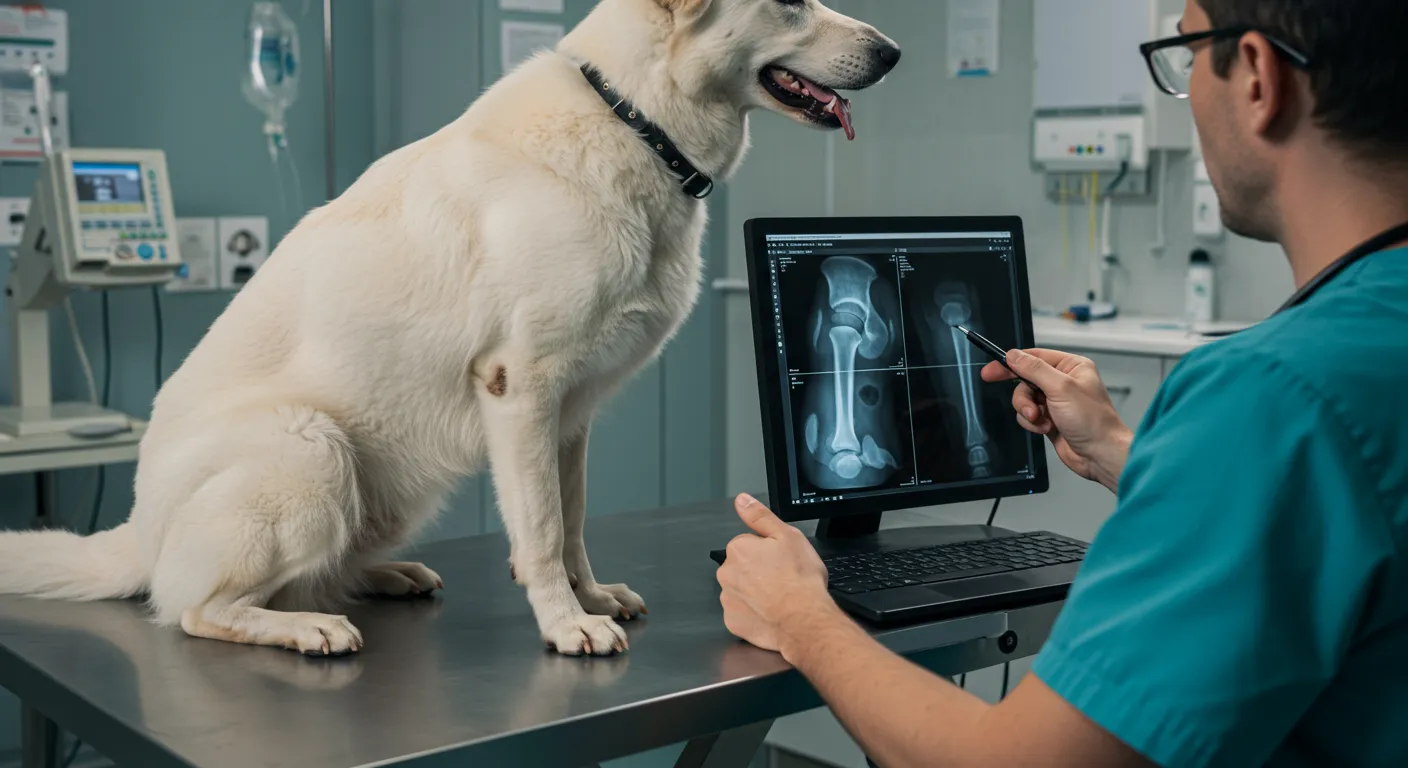
The genes that contribute to hip dysplasia risk are scattered across many chromosomes. Studies using genome-wide association approaches have identified multiple chromosomal regions containing risk variants for hip dysplasia in German Shepherds, none of which are located near the Extension locus on chromosome 5.
This chromosomal separation means that the e allele and hip dysplasia risk alleles are inherited independently. A dog can be e/e with excellent hips, e/e with poor hips, E/e with excellent hips, or E/e with poor hips. Every combination is possible because the genes are not linked.
I have examined hip scoring data from registered Berger Blanc Suisse and white German Shepherd populations alongside data from pigmented German Shepherd populations. The frequency distribution of hip scores does not differ between white and pigmented dogs when population of origin and breeding practices are controlled for. White shepherds are not more or less prone to hip dysplasia than their genetic relatives with pigmented coats.
This point bears emphasis because I have encountered veterinary professionals who advise against purchasing white shepherds based partly on perceived health risks. As I document in my comprehensive article on health and the white coat, these concerns are not supported by the evidence when examined by genetic mechanism and epidemiological data.
Hip Scoring Systems
Several standardized systems exist for evaluating hip conformation radiographically. The most widely used internationally are the FCI grading system, the OFA (Orthopedic Foundation for Animals) system, and PennHIP. Each provides a different approach to measuring and categorizing hip joint quality.
The OFA system evaluates hip morphology at a single time point, typically around 24 months of age when skeletal maturity is near complete. Hips are graded excellent, good, fair, borderline, or dysplastic (mild, moderate, severe). Only dogs rated excellent, good, or fair are considered breeding quality under most breeding program guidelines.
PennHIP measures joint laxity under distraction and uses a distraction index (DI) to quantify looseness. Studies suggest PennHIP has higher predictive validity for future arthritis development than morphological scoring, and it can be performed as early as 16 weeks of age.
The FCI system used by European breed clubs provides a grade from A through E, with A representing excellent hip conformation and E representing severe dysplasia. Most European Berger Blanc Suisse breed clubs require grade A or B for breeding.
Genetic Diversity and Hip Health
There is a real connection between genetic diversity and musculoskeletal health, but it operates through inbreeding rather than through coat color. I discuss this in detail in my article on inbreeding coefficients and population health in white shepherd lines.
As inbreeding increases, harmful recessive alleles including those that predispose to hip dysplasia have higher probability of appearing in homozygous combinations. A population with high COI values can show elevated rates of conditions like hip dysplasia not because of any specific gene but because of the general effect of homozygosity across the genome.
This distinction is important. The elevated concern about hip dysplasia in white shepherd populations, to the extent it is warranted, should be framed as a population genetics concern about inbreeding depression rather than a coat color genetics concern. The white coat is not the cause. The bottlenecked founding population and restricted breeding circles are the factors that require management.
Practical Breeding Recommendations
Hip scoring all breeding stock is the most direct intervention available to breeders. Every German Shepherd and Berger Blanc Suisse intended for breeding should be evaluated using a recognized standardized system and should meet the minimum threshold required by their relevant breed club.
Beyond basic screening, several approaches help reduce dysplasia prevalence over generations:
Select breeding pairs based on extended pedigree data. Dogs from lines with consistently excellent hip scores are better candidates than dogs with individually excellent scores but relatives with poor scores. The polygenic nature of the trait means that family history reflects the genetic load more accurately than individual scores alone.
Avoid very high inbreeding coefficients. As I argue in my genetic diversity article, keeping COI values low is associated with better overall health metrics including musculoskeletal health.
Use international and outcross partners strategically. Dogs from breeding programs with different pedigree backgrounds contribute new combinations of alleles at the multiple loci influencing hip development.
Implement optimal puppy rearing protocols. Given that environmental factors contribute 60 to 75 percent of hip dysplasia variation, providing appropriate nutrition, controlled exercise, and body weight management is as important as genetic selection.
The white shepherds and Berger Blanc Suisse I have followed through long-term research show the same range of hip outcomes as their pigmented relatives when these management practices are applied consistently. Their white coat predicts nothing about their joints. Their pedigrees, their hip scores, and their management predict a great deal.