If you have read my article on hip dysplasia genetics, you already understand the core framework for polygenic orthopedic conditions in shepherds. Elbow dysplasia follows the same genetic logic, but it presents as a more heterogeneous problem because the term covers three distinct developmental abnormalities rather than one. Getting elbow health right in a breeding program requires understanding each of them separately.
I have evaluated elbow scoring records and genetic data from several hundred Berger Blanc Suisse and white German Shepherd dogs over the years. The same finding emerges every time: elbow health in white shepherds tracks with pedigree quality and breeding practices, not with coat color. The e/e genotype that produces the white coat has no mechanistic connection to any of the conditions grouped under elbow dysplasia.
What Elbow Dysplasia Actually Means
The term elbow dysplasia encompasses three distinct pathological processes that can affect the developing elbow joint:
Ununited Anconeal Process (UAP): The anconeal process is a bony protrusion on the ulna that should fuse to the main ulnar body by approximately five months of age in German Shepherds. When it fails to fuse, the loose fragment causes joint instability, cartilage erosion, and secondary osteoarthritis. UAP is one of the more dramatic presentations and often requires surgical intervention.
Fragmented Medial Coronoid Process (FCP): The medial coronoid process is a small projection on the ulna that articulates with the radius and humerus. FCP, sometimes called fragmented coronoid process or simply coronoid disease, involves fissuring or fragmentation of this process. It is the most common form of elbow dysplasia in German Shepherds. The fragments or fissures create a chronic source of joint inflammation and cartilage wear.
Osteochondrosis Dissecans (OCD) of the Elbow: Osteochondrosis is a disruption in the normal conversion of cartilage to bone during skeletaldevelopment. In the elbow, it most commonly affects the medial humeral condyle, where abnormal cartilage creates a flap or defect that causes joint pain and secondary changes.
All three conditions share a common feature: they disrupt normal joint mechanics during development and, left unaddressed, lead to secondary osteoarthritis that produces chronic pain and reduced function in adult dogs. They also share a common hereditary basis that breeding programs can meaningfully influence.
Polygenic Inheritance in the Elbow
Like hip dysplasia, elbow dysplasia is a polygenic trait. No single gene determines whether a dog will develop UAP, FCP, or OCD. Instead, many genes each contribute small additive effects to the developmental biology of the elbow joint. The total genetic liability, combined with environmental and developmental factors, determines whether a dog crosses the threshold into disease.
Heritability estimates for elbow dysplasia in German Shepherds range from approximately 25 to 45 percent across different studies, broadly similar to hip dysplasia heritability. The variation between studies reflects differences in population sampling, measurement methods, and environmental conditions across study cohorts.
The three component conditions do not share identical genetic architecture. Research using quantitative genetic methods suggests that UAP, FCP, and OCD have partly overlapping and partly distinct genetic contributions. Dogs in high-risk lines for FCP are not necessarily at elevated risk for UAP, and vice versa, even within the same breed.
This conditional independence matters for how breeders interpret elbow scoring results. A dog from a line with historic FCP problems is not automatically at elevated risk for all elbow pathology types. Line-specific risk should be evaluated for each condition, not assumed to be global.
Why White Coat Has No Relevance
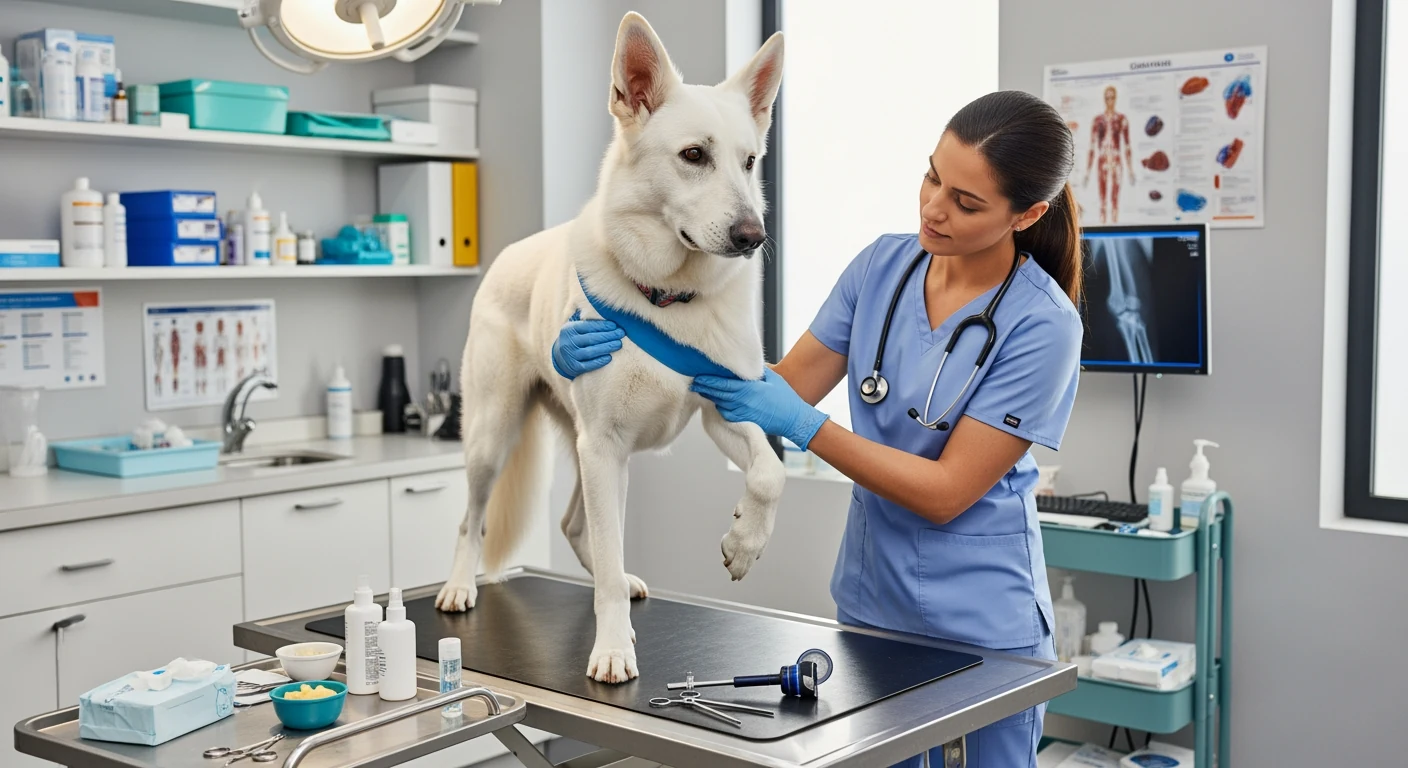
I want to address this directly because I have encountered breeders, veterinary professionals, and prospective buyers who assume that white coat color signals a propensity for orthopedic problems. The reasoning is usually vague: white shepherds are less robust, or the breeding bottleneck that produced white dogs also concentrated health problems.
The first claim is not supported by mechanism. The Extension locus on chromosome 5, which controls whether a dog produces the e allele responsible for the white coat, has no functional relationship to the genes regulating joint development. A dog can be e/e with excellent elbows, e/e with poor elbows, E/E with excellent elbows, or E/E with poor elbows. The genotypes are inherited independently because they involve different chromosomes and different biological pathways.
The second claim is more nuanced. There is a kernel of truth here, but it is consistently misattributed. As I discuss when covering inbreeding and genetic diversity in white shepherd populations, the founding populations of modern white shepherd and Berger Blanc Suisse breeds did pass through demographic bottlenecks. Those bottlenecks, combined with restricted breeding circles, can elevate the frequency of any deleterious allele that was present in founders, including alleles at loci influencing joint development.
This is an inbreeding concern, not a coat color concern. The mechanism is elevated homozygosity across the genome, not any specific linkage between white coat genetics and orthopedic genetics. A pigmented German Shepherd population with a similarly narrow pedigree base would show the same pattern.
When elbow scoring data from Berger Blanc Suisse registries are compared to German Shepherd Association data from populations of similar geographic origin and similar pedigree depth, the elbow grade distributions do not differ significantly. Both populations produce the same range of outcomes when breeding practices are comparable.
Environmental and Developmental Factors
Genetic predisposition sets the baseline risk, but the expressed severity of elbow dysplasia depends substantially on developmental conditions. This is not surprising given that heritability estimates leave 55 to 75 percent of the variance unaccounted for by genetics alone.
The most relevant developmental factors include:
Growth rate and body weight: Rapid weight gain places excessive mechanical load on the developing elbow joint. The elbow undergoes complex, precisely timed developmental events during the first four to six months. Overfeeding large breed puppies to accelerate size causes the mechanical and nutritional environment to mismatch what the joint developmental program expects.
Calcium and phosphorus balance: The ratio of dietary calcium to phosphorus during growth is critical for appropriate bone and cartilage mineralization. Both excess and deficiency can disrupt normal joint development. Large breed puppy foods formulated to appropriate Ca:P ratios protect against nutritionally driven joint developmental problems.
Exercise loading during growth: High-impact repetitive loading of developing elbows on hard surfaces is a known risk factor for OCD lesion development. The cartilage canals that supply nutrients to developing cartilage are susceptible to compression injury, and repetitive impact can disrupt the blood supply that drives normal ossification. Controlled exercise on varied, compliant surfaces is preferable to repetitive leash work on pavement during the first six months.
Growth velocity genetics: Some dogs are genetically programmed to grow faster than others, and rapid genetic growth rate itself constitutes a risk factor for developmental orthopedic disease regardless of feeding practices. This means that selecting for extremely large body size in a shepherd breeding program inherently trades off some degree of orthopedic risk.
Elbow Scoring Systems
Several standardized approaches exist for evaluating elbow health. In Europe, the FCI-endorsed OFA/IEWG grading scheme is widely used. Elbows are graded zero through three, where zero indicates no dysplastic changes, one indicates minimal arthritic changes or a minor primary lesion, two indicates moderate arthrosis or a clearly visible primary lesion, and three indicates severe arthrosis or major primary lesion involvement.
Most European Berger Blanc Suisse breed clubs require grade zero or grade one for breeding certification. Some clubs apply this requirement to both elbows, meaning a dog with one grade zero and one grade one elbow passes, but a dog with one grade two elbow fails regardless of the other side.
In North America, OFA evaluates elbow radiographs and assigns a normal or grade one, two, or three dysplastic result. The OFA database allows breeders to look up the elbow history of dogs registered by name, which makes pedigree research for elbow health relatively straightforward in North American shepherd populations.
Computed tomography (CT) provides greater sensitivity than radiography for detecting fragmented coronoid process, because CT imaging reveals the three-dimensional structure of the joint and can detect fissures not visible on standard projections. Some progressive breeding programs require CT evaluation of breeding candidates in addition to standard radiographic grading.
Practical Recommendations for Breeders
The most important action available to breeders is consistent elbow evaluation of all breeding candidates. This sounds obvious, but the proportion of German Shepherd and Berger Blanc Suisse dogs entered in elbow scoring databases has historically been lower than in hip scoring databases, partly because elbow dysplasia generates less public attention despite its welfare impact.
For planning matings with elbow health as a criterion, extended pedigree analysis adds substantially more information than individual scores alone. A dog with a grade zero elbow from a family of grade zero and grade one dogs is a meaningfully better candidate than a grade zero dog whose siblings and cousins score two and three. The polygenic nature of the trait means that family average reflects the genetic load more accurately than any individual’s phenotype.
The practical framework I recommend to breeders is identical to the one I outlined for hip health:
Select on both individual score and family average. Use pair selection tools that calculate expected offspring distributions based on the elbow grades of both candidate parents’ relatives. Avoid high-inbreeding pairings, because inbreeding elevation in COI increases the probability that risk alleles at multiple loci will appear in homozygous combinations in offspring. Refer to the complete discussion of inbreeding coefficients and their health implications for the framework behind this recommendation.
Consider international and outcross pairings strategically. Bringing genetics from programs with different pedigree bases introduces new combinations at the multiple loci influencing joint development, reducing the genetic load that any single restricted gene pool accumulates over generations.
Apply appropriate puppy rearing protocols without exception, regardless of the genetic quality of the parents. The most carefully selected pairing benefits from correct nutritional management, controlled growth rate, and appropriate exercise during the developmental window.
The Connection to Coat Color Testing
I want to close with a point about comprehensive health testing in white shepherd programs. DNA testing for coat color genetics, whether for the E locus allele frequencies or the hidden pattern alleles at the Agouti locus, is part of responsible breeding practice. But it sits in a completely separate category from the orthopedic and health screening that determines the long-term welfare of the dogs produced.
Breeders who invest in comprehensive color genotyping but skip elbow and hip scoring are optimizing the wrong dimension of their program. Color genetics predicts aesthetics. Orthopedic screening predicts pain and functional capacity in the dogs you produce. Both matter, but in a well-constructed breeding program, health screening precedes and informs all other selection decisions.
The white shepherd and Berger Blanc Suisse communities have access to robust health databases, genetic diversity tools, and a growing understanding of the molecular basis of conditions like elbow dysplasia. Using these tools consistently is what separates programs that produce sound dogs from programs that produce beautiful ones.
Frequently Asked Questions
Are white German Shepherds more prone to elbow dysplasia than pigmented shepherds?
No. The Extension locus determining white coat color lies on a different chromosome from any of the genes currently associated with elbow dysplasia risk. Elbow health outcomes in white shepherd populations track with pedigree depth and breeding practices, just as they do in pigmented shepherd populations. Where elevated rates are observed in white shepherd lines, the cause traces to founder demographics and inbreeding, not to white coat genetics.
At what age should elbow scoring be performed for a breeding candidate?
Standard radiographic evaluation requires skeletal maturity, which in German Shepherds occurs around 18 to 24 months. OFA preliminary evaluations from 12 months provide early information but carry less predictive value than evaluations at full maturity. CT evaluation can identify fragmented coronoid process at earlier ages with greater sensitivity than radiography. Most breed clubs require final elbow grades before breeding clearance.
Can two elbow-cleared parents produce a dysplastic puppy?
Yes, for the same reason that hip-cleared parents can produce hip-dysplastic offspring. Elbow dysplasia is polygenic with heritability in the 25 to 45 percent range. Two parents with grade zero elbows substantially reduce the risk compared to unscreened parents, but they carry some proportion of the many alleles influencing joint development. Environmental factors during puppy growth contribute the remaining variance.
Is elbow dysplasia painful for affected dogs?
Depending on severity and the specific condition, yes. FCP and OCD lesions produce joint inflammation that can be clinically silent early but progresses to chronic pain with secondary osteoarthritis in many dogs. UAP causes mechanical joint instability that is typically more immediately symptomatic. Dogs with grade two or three elbow dysplasia often require veterinary management and may need surgical intervention for the best quality of life outcomes.
Should elbow scoring be prioritized over coat color DNA testing in a breeding program?
The two tests serve entirely different purposes, so prioritization is not the right framing. Coat color testing predicts aesthetics and offspring phenotype distributions. Elbow screening predicts orthopedic health outcomes. A responsible breeding program for white shepherds or Berger Blanc Suisse will include both, executed at the appropriate developmental stage for each. Elbow and hip evaluations at maturity, coat color panels and health DNA panels earlier. They are not alternatives to each other.